Your TFSA is not a savings account
The name is the most misleading thing about it. A Tax-Free Savings Account is a container, not a product: it grows tax-free, pays out tax-free, never expires, and never touches your Old Age Security. How the room works, the one withdrawal catch, and who gets to keep it when you're gone.
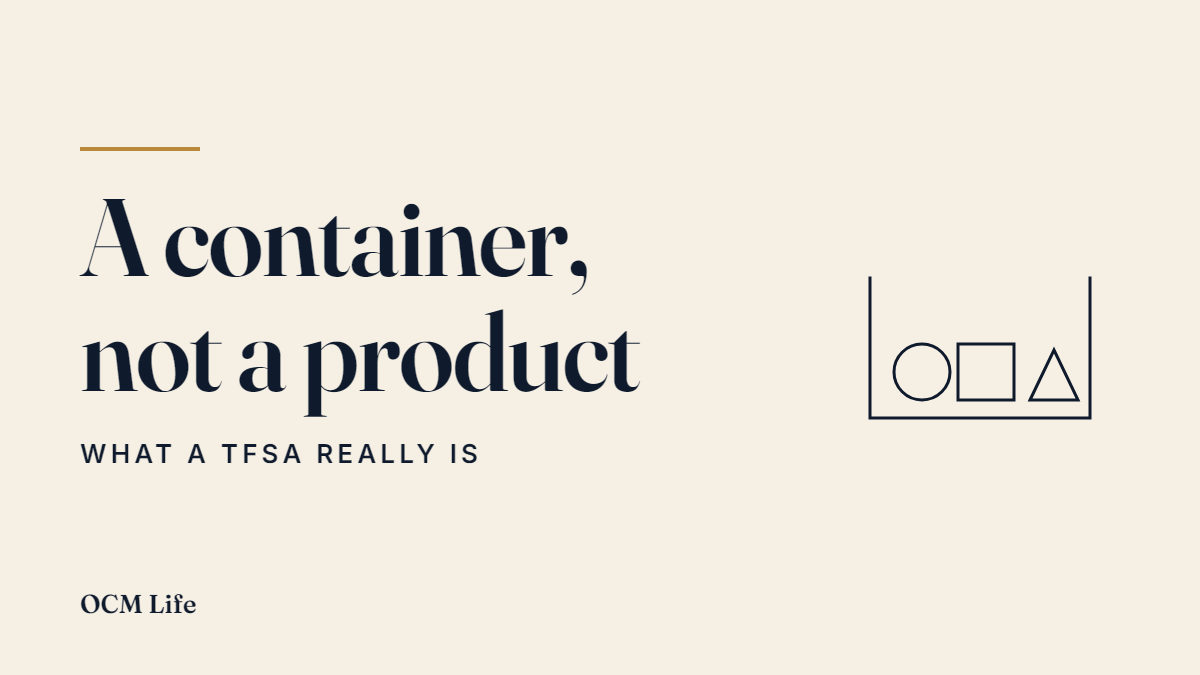
It is called a savings account. That name is the most misleading thing about it. A Tax-Free Savings Account (TFSA) is not a product you buy; it's a container, and this is the contents piece. A savings account is just one of the things you can keep inside it, along with Guaranteed Investment Certificates (GICs), stocks, funds, and plain cash. We've compared it to the RRSP before, and that piece covers which account fits when. This one goes deeper on the container itself: what it does, how the room works, and who gets to keep it when you're gone.
Tax-free both ways
The Registered Retirement Savings Plan (RRSP) is tax-deferred. Your gains grow on top of each other, never removing the tax part, until you finally withdraw, and then the withdrawal is income. What you put in earns a deduction now; what comes out gets taxed later.
The TFSA is both. It grows tax-free, compounding on itself, the whole amount of the gain, and the withdrawal is tax-free too, because you already paid the taxes on the money you put into it. There's no deduction on the way in, and no tax bill on the way out.
It's your money, and you put it into it. You invest in it tax-free forever.
No age limit, and it never expires
There is no upper age limit on a TFSA and no forced conversion. An RRSP has an expiry date: by the end of the year you turn 71 it has to become something else, and that something starts forcing money out. A TFSA just keeps going. For older readers wondering whether there's still a point in one, that's the answer: the account has no clock on it, and contribution room keeps accumulating every year you're a Canadian resident, at any age.
Withdrawals don't count as income
Money coming out of a TFSA isn't income. It doesn't go on your tax return, and the Canada Revenue Agency (CRA) confirms that neither the income earned inside the account nor the amounts withdrawn reduce federal income-tested benefits, including Old Age Security (OAS) and the Guaranteed Income Supplement (GIS) (Canada.ca, TFSA guide for individuals). No tax drag while it grows, no income when you withdraw, no tax impact on the way out. It doesn't touch your OAS.
That combination is why the account matters most exactly where people assume it matters least: in retirement, where every dollar of RRSP or RRIF withdrawal is income that counts toward the OAS clawback, and every dollar out of a TFSA is invisible to it.
How the room works
The annual limit for 2026 is $7,000, the third year in a row at that level. The limit is indexed to inflation and rounded to the nearest $500, which is why it climbs in steps rather than every year (Canada.ca, calculate your TFSA contribution room).
The part people miss: the room accumulates whether or not you've ever opened an account. From the year you turn 18, as long as you're a Canadian resident with a Social Insurance Number, every year's limit gets banked for you, used or not (Canada.ca, opening a TFSA). Someone who was 18 or older when the program started in 2009 and has never contributed a dollar is sitting on $109,000 of room in 2026.
One provincial wrinkle: in provinces and territories where the age of majority is 19, you can't sign the paperwork to open a TFSA until 19, but the room from the year you turned 18 carries over and is waiting when you do.
The withdrawal catch
You can take money out at any time, for any reason, with no tax. The catch is on the way back in. A withdrawal doesn't restore your contribution room until January 1 of the following year. Take out $10,000 in June and, unless you have unused room already sitting there, you can't put that $10,000 back until January, when it returns along with the new year's limit (Canada.ca, calculate your TFSA contribution room).
Re-contribute in the same calendar year without the room and the CRA treats it as an over-contribution, taxed at 1% per month on the excess for as long as it stays in the account. It's the single most common TFSA mistake, and it's entirely a timing mistake.
Who gets it when you're gone
Two designations exist, and the difference between them is the whole game (Canada.ca, death of a TFSA holder).
A successor holder can only be a spouse or common-law partner. Named as successor, they simply become the new holder of the account at death: the TFSA keeps existing, keeps its tax-exempt status, keeps growing tax-free, and none of it uses up their own contribution room. The account doesn't skip a beat.
A designated beneficiary can be anyone: a spouse, a child, a sibling, a charity. Here the account itself ends. The value at the date of death passes to the beneficiary tax-free, but any growth between the death and the payout is taxable to whoever receives it, and the money only goes back inside a tax shelter if the beneficiary has room of their own. (A spouse named as beneficiary rather than successor has a special window to move the money into their own TFSA without using room, but it takes a form and a deadline instead of happening automatically.)
Either designation also keeps the account out of the estate: it passes directly, outside the will, with no probate on it. How much that's worth depends on where you live. Alberta charges a flat court fee capped at $525 no matter the estate's size, while Ontario and British Columbia charge a percentage that scales with the estate, roughly 1.5% and 1.4% respectively above the first $50,000, where a large estate can owe five figures. What the rest of the estate picture looks like, province by province, is a piece of its own.
Where to get one
Banks, credit unions, insurance companies, and trust companies can all issue TFSAs, with different savings and investment options inside (Canada.ca, opening a TFSA). The container is the same everywhere; the contents, and the fees on the contents, are where issuers differ.
The handback
The mechanics are the same for everyone: the room, the January rule, the two designations. What the account is for is not. For one household it's the emergency fund, for another it's the retirement income that never touches the clawback, and for another it's the cleanest asset in the estate. The name on the account says savings. The paperwork says container. What goes inside it, and who's named on it, are the decisions, and both cost nothing to get right.
This is general information, not advice. Figures are as of August 2026 and change with legislation and indexation; check the live numbers with the CRA and your own account statements before relying on them.
Sources
- Canada Revenue Agency — Opening a TFSA (eligibility, age of majority, issuers)
- Canada Revenue Agency — Calculate your TFSA contribution room (annual limit, carry-forward, withdrawals)
- Canada Revenue Agency — TFSA guide for individuals (income-tested benefits, over-contribution tax)
- Canada Revenue Agency — Death of a TFSA holder (successor holders and designated beneficiaries)
Assets minus debts, eight snapshots, the mix (home equity, registered, everything else) and one chart of the line that matters. Excel and Google Sheets. Part of the Household Money System.
See what's inside →$9 for this sheet, $39 for the pack of four. No product inside. All sales final.
Keep getting answers like this