Where to keep your cash: high-interest savings, GICs, and the cost of leaving it in chequing
Money sitting in a chequing account earns almost nothing while inflation chips away at it. Here's how high-interest savings accounts and GICs actually work, what each earns as of mid-2026, and when each one fits.
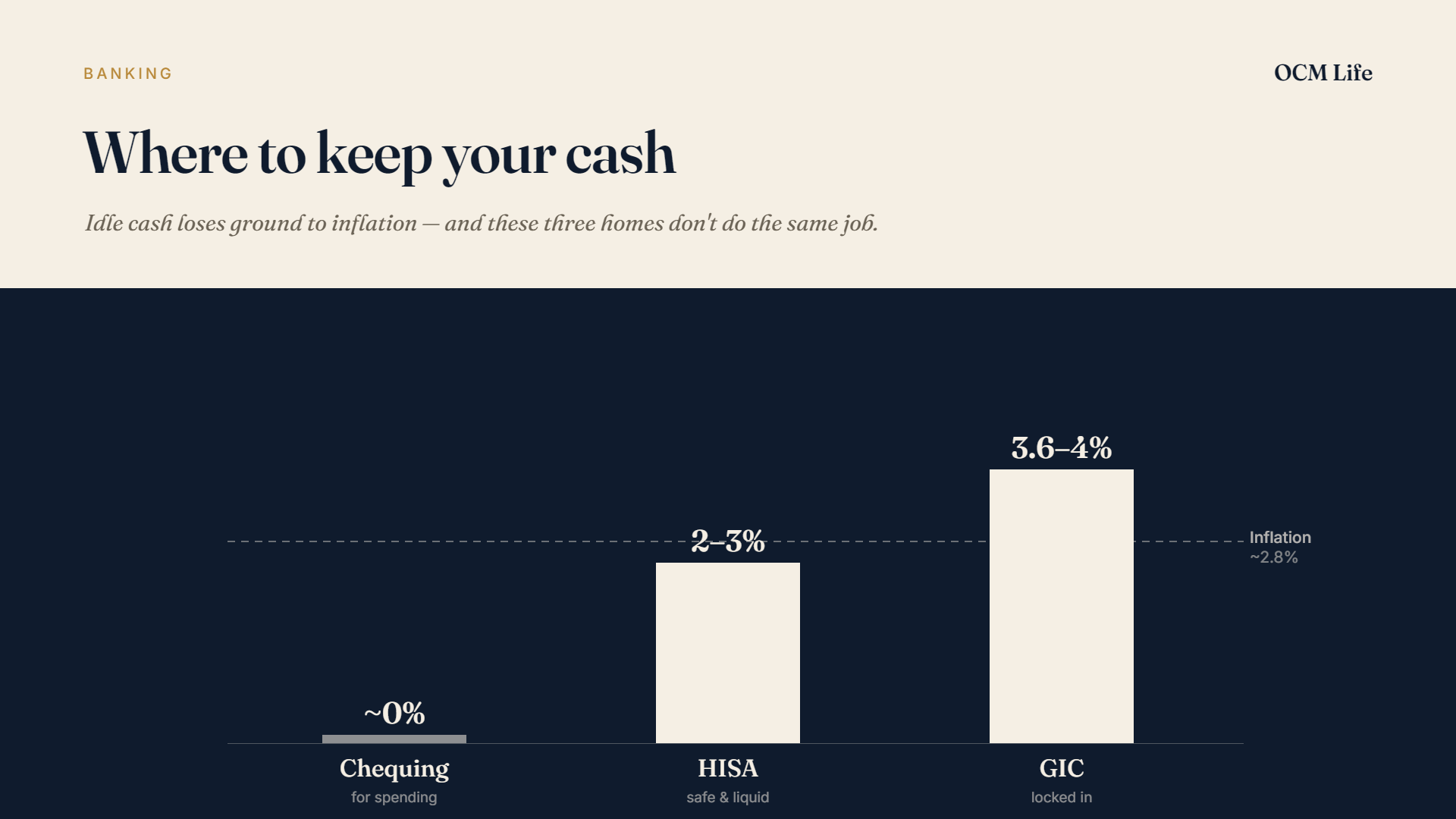
Cash you're not spending has three common homes: your chequing account, a high-interest savings account, and a guaranteed investment certificate (GIC). They're not interchangeable, and the gap between the worst and best choice is real money.
The short version:
- A chequing account is for spending. It pays close to nothing, so cash parked there loses ground to inflation month after month.
- A high-interest savings account (HISA) pays interest and stays fully liquid, suited to an emergency fund or money you might need soon.
- A GIC pays a little more but locks your money up for a set term, suited to money with a known timeline you won't touch.
What your chequing account is actually doing
A chequing account is built for moving money, not growing it. Most pay an interest rate at or near zero. With inflation running about 2.8% in early 2026, every dollar left idle there loses roughly that much in purchasing power over a year.
For the float you need to cover bills, that's fine. It's the price of having money on hand. For a larger balance sitting untouched for months, it's a slow leak you won't see on any statement.
How a high-interest savings account works
A HISA pays a meaningful interest rate while letting you withdraw any time. The rate is variable: it moves with the Bank of Canada's policy rate, which sits at 2.25% as of June 2026, down from a peak of 5.0% in 2024. As of mid-2026, everyday HISA rates run roughly 2% to 3%, with promotional rates reaching about 4.5% for a limited window. The online banks and credit unions, names like EQ Bank or Simplii, generally pay more than the big banks' standard savings accounts, because they carry less overhead.
What the rate alone won't tell you: a 2% to 3% HISA roughly keeps pace with today's inflation, no more. It protects your cash; it doesn't grow it. That makes it the right tool for money you need safe and reachable, and the wrong tool for money meant to build wealth over decades. (For that, the questions are which account to use and what to hold inside it, which is a separate piece.)
And the rate isn't the whole return. In a regular, non-registered account, every dollar of HISA interest is taxed as income, at your marginal rate. Hold the same savings inside a TFSA and that interest is tax-free, which is often exactly why a HISA belongs in one. (RRSP vs TFSA covers how that account works, and how tax brackets work explains what "your marginal rate" means.)
How a GIC works
A guaranteed investment certificate (GIC) is a straightforward trade: you lock your money in for a fixed term, anywhere from 30 days to five years or more, and in return the rate is fixed and usually a little higher than a HISA. As of June 2026, one-year GIC rates top out around 3.6% and five-year terms around 4%, with online banks and credit unions again paying more than the big banks.
The cost of that higher rate is access. A standard, non-redeemable GIC can't be cashed early without a penalty, so it suits money with a date attached: a tax bill due next spring, a renovation in two years, a down payment you won't touch before then. Lock in money you might actually need, and the early-withdrawal penalty can swallow the extra interest you were chasing.
One way to soften the lock-in is laddering: splitting the money across GICs that mature in different years, so a portion frees up each year while the rest keeps earning the longer-term rate.
The safety question: is your money protected?
Yes, within a limit worth knowing. Deposits at banks that belong to the Canada Deposit Insurance Corporation (CDIC) are insured up to $100,000 per depositor, per category, per member institution, which covers HISAs and most GICs if the bank itself fails. Credit unions aren't covered by CDIC but by provincial deposit insurance, which varies by province, and in some provinces covers deposits with no dollar cap.
The practical point: for balances above $100,000 at a single institution, the coverage math is worth a look. Splitting across institutions or categories can keep everything insured.
Matching the money to the account
Two questions sort it: how soon you might need the money, and whether you need it safe or want it to grow. Money for spending and emergencies wants liquidity: chequing for the float, a HISA for the cushion. Money with a fixed date and no need for access can earn a bit more locked in a GIC. Money meant to grow over many years isn't a "where to keep cash" question at all, and a separate piece takes that one up.
This is general information, not advice. Rates move, and the figures here are as of mid-2026; confirm the live numbers before you rely on them.
Sources
- Bank of Canada — policy interest rate decisions
- Canada Deposit Insurance Corporation — what's covered and the $100,000 limit
- Financial Consumer Agency of Canada — savings accounts and GICs
Keep getting answers like this