CPP and OAS: one you paid into, one you didn't
Canada's two public pensions land in the same bank account, but they are different machines: one built from your paycheques, one from your years in the country. How each works, what the timing window does to the payment, and where the clawback actually bites.
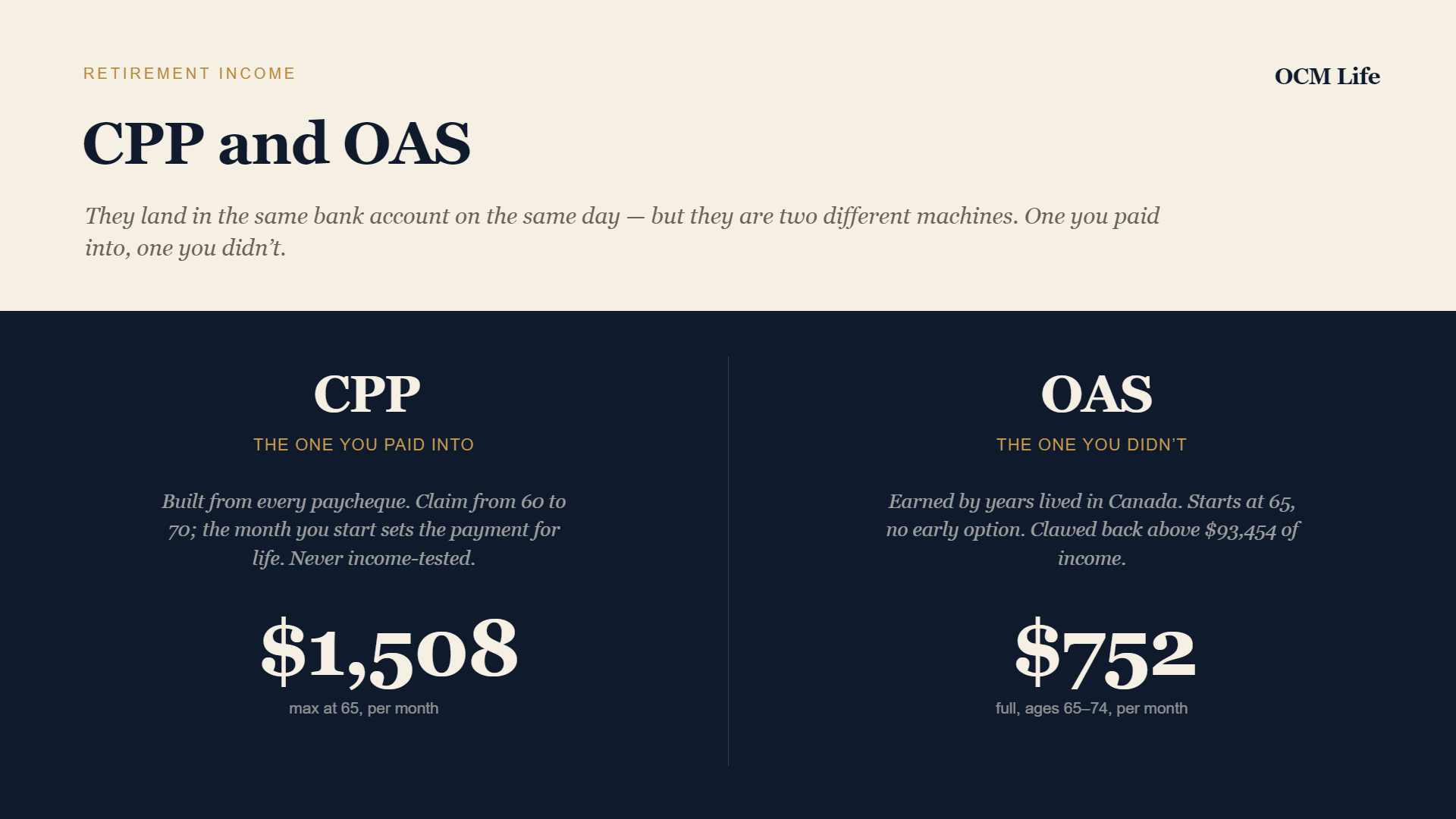
Canada's two public pensions usually get mentioned in one breath, and they land in the same bank account on the same day. They are different machines. The Canada Pension Plan (CPP) is the one you paid into: you and your employer each put in a slice of every paycheque, the deduction most of us have watched leave a pay stub for decades, and the pension it pays back reflects that earnings history. Old Age Security (OAS) never touched your paycheque. It is paid out of general tax revenue and earned by years lived in Canada after age 18: ten years of residence to get anything, forty for the full pension. One you paid into, one you didn't. That is the basic distinction, and almost everything else about the two programs follows from it.
Where they came from
OAS is the older idea. Canada's first federal old-age support arrived in 1927, means-tested and payable at 70. The Old Age Security Act of 1952 made it universal, still at 70, and between 1965 and 1970 the eligibility age came down in stages to 65. In 1967 a low-income companion was bolted on (more on that below). The income test returned in a new form in 1989, when the recovery tax most people call the clawback was introduced for higher-income recipients, with a threshold indexed to inflation ever since. In 2012 the federal government legislated a gradual move of the eligibility age to 67; in 2016 a new government cancelled the change before it took effect, and 65 it remains. One recent addition: since July 2022, everyone 75 and over gets an automatic 10% increase.
CPP is the younger program. It was legislated in 1965, began collecting contributions in 1966, and paid its first retirement pensions in 1967, with Quebec launching its own parallel plan, the Quebec Pension Plan (QPP), at the same time. A major 1998 reform raised contribution rates and created the CPP Investment Board to invest the fund, and since 2019 an enhancement has been phasing in that will eventually lift the pension from replacing about a quarter of average work earnings to about a third.
The point of the history is not trivia. Both programs have been changed before, on eligibility ages, thresholds, and contribution rates, and they can be changed again. What follows are the rules as of July 2026.
The CPP timing window
The standard start age is 65. In 2026 the maximum pension at 65 is $1,507.65 a month, though the average new recipient gets about $925; the maximum takes roughly 39 years of contributions at or near the earnings ceiling (Canada.ca payment amounts).
The window actually runs from 60 to 70, and the month you start sets the payment for life. Start early and the pension shrinks by 0.6% for every month before 65, a 36% cut if you start right at 60. Wait past 65 and it grows by 0.7% for every month of patience, a 42% boost at 70. Nothing is gained by waiting past 70.
Waiting is the part most people skip past, so it's worth spelling out what it buys. The increase is set by formula, not by markets, and the bigger pension is indexed to inflation for as long as you live. No product on a shelf offers that combination. The catch is just as plain: waiting means years of collecting nothing. The person who defers from 65 to 70 pulls ahead of the person who didn't at around age 82, and most 65-year-olds today can expect to live into their mid-80s. So the wait wins more often than not, but "more often than not" is exactly the kind of phrase that hides individual lives.
Almost nobody waits. Fewer than 5% of Canadians defer CPP past 65, and under 2% hold out until 70, while roughly nine in ten have claimed by their 65th birthday, according to a 2020 study by the Canadian Institute of Actuaries and the Society of Actuaries (The CPP Take-Up Decision).
One you paid into, one you didn't. Almost everything else about the two programs follows from it.
The OAS timing window
OAS starts at 65 and can be deferred to 70, gaining 0.6% per month, a maximum 36% boost. There is no early option, which surprises people: CPP lets you start at 60, OAS does not. The full pension is $751.97 a month for ages 65 to 74 this quarter (July to September 2026), rising to $827.17 at 75 with the automatic 10% increase, and the amounts adjust quarterly for inflation (Canada.ca OAS amounts).
The clawback, with real numbers
The clawback applies only to OAS. CPP is never income-tested. Formally it's the OAS recovery tax: once net income crosses a threshold, the pension is reduced by 15 cents for every dollar above it.
Two thresholds matter right now, because the system runs on a one-year lag. Payments from July 2026 to June 2027 are set against 2025 income, where the clawback starts at $93,454. Income earned in 2026 is measured against $95,323 and shapes payments starting July 2027 (Canada.ca quarterly figures).
On the current period's numbers, for a recipient aged 65 to 74: the pension starts shrinking at $93,454 of net income, is roughly half gone around $123,000, and is fully gone at $152,062 ($157,923 for those 75 and over, whose base pension is larger). For income earned in 2026, full recovery lands at $155,109 for ages 65 to 74.
One mechanic worth knowing: the income test looks at net income on the tax return, so withdrawals from a Registered Retirement Income Fund (RRIF) count toward it, while TFSA withdrawals don't. A single large withdrawal or asset sale can push one year's income across the line and trim the following year's OAS.
The low-income companion
The 1967 bolt-on mentioned above is the Guaranteed Income Supplement (GIS), and it's the piece of the system most often left unclaimed. GIS is a monthly, tax-free top-up for OAS recipients with little other income: up to $1,123.17 a month for a single senior this quarter. Where the OAS clawback takes 15 cents per dollar from higher earners, GIS works the same way in miniature at the bottom of the income scale, shrinking by 50 cents for every dollar of other income (OAS itself doesn't count) and reaching zero around $22,800 for a single senior (Canada.ca GIS amounts).
Two mechanics decide who actually keeps it. First, GIS renews only if a tax return is filed each year; a missed filing stops the payments, even at zero income. Second, the same income test applies here: RRSP and RRIF withdrawals reduce GIS dollar for dollar of income, TFSA withdrawals don't, which is one more entry in the long ledger of differences between the RRSP and the TFSA. What RRIF withdrawals do to all of the above is a subject of its own.
What pulls each way
There's no universal answer on timing, but the questions are the same at every kitchen table.
The first is how long the money has to last. The break-even math turns almost entirely on how many years the payments run, and health and family history say more about that than any calculator.
The second is what fills the gap. Deferring only works if the years between 60 and 70 are paid for some other way: savings, a workplace pension, work that hasn't worn out its welcome. Someone without that bridge can't wait, and taking CPP at 60 to fund real years of living isn't a mistake. It's what the early option is for.
The third is the clawback. For someone still earning well at 65, starting OAS right away can mean handing a slice of it straight back through the recovery tax. Deferring while income is high can pay twice: a bigger pension later, and fewer years spent above the threshold.
And at the other end of the income scale, GIS flips the math. Every extra dollar of CPP trims GIS by 50 cents, so a bigger, deferred CPP can be worth half its sticker price to a low-income retiree. The top of the income range and the bottom face opposite arithmetic.
A last note for Quebec readers: workers there contribute to the QPP rather than CPP. The two plans mirror each other closely on amounts and timing rules, with modest differences in contribution rates, and benefits are coordinated through Retraite Québec for people who worked under both.
The handback
The mechanics above are the part that's the same for everyone: the formulas, the thresholds, the windows. What they add up to depends on numbers only the person holds, starting with the contribution record sitting in a My Service Canada Account, the other income waiting in each year of the plan, and an honest read on health and horizon. The programs have moved before and will move again. The start date, though, is one of the few retirement decisions that is chosen once and paid out for life.
This is general information, not advice. Figures are as of July 2026 and change with indexation and legislation; check the live numbers with Service Canada and the CRA before relying on them.
Sources
- Government of Canada — CPP payment amounts (2026 maximum and average) and how the CPP retirement pension is calculated (early/late adjustment factors)
- Government of Canada — OAS pension amounts and deferral and quarterly indexation and recovery tax threshold
- Government of Canada — Maximum benefit amounts and related figures, CPP 2026 / OAS July to September 2026
- Government of Canada — GIS payment amounts
- Canadian Institute of Actuaries / Society of Actuaries — The CPP Take-Up Decision: Risks and Opportunities (July 2020)
Keep getting answers like this