Three to six months of what? Sizing an emergency fund on the gap, not the salary
The most repeated rule in personal finance is also the least specific. What "three to six months" actually depends on: what keeps arriving when the paycheque stops, what must keep leaving, and why the same rule produces a $5,000 answer for one household and a $40,000 answer for another.
$729. That is the most Employment Insurance will pay for a week of lost work in 2026, no matter what the paycheque used to be. EI replaces 55% of insurable earnings up to a ceiling of $68,900 a year, which means someone who earned $65,000 gets a meaningful fraction of their income back and someone who earned $150,000 gets the same $729 a week, about a quarter of theirs. The most repeated rule in personal finance, keep three to six months of expenses on hand, was built to cover a gap. It never says whose gap, and that is where the rule stops being useful.
Followed as a slogan, the default produces strange results. Some households hold far too little. Others hold years of security in a chequing account while carrying a car loan, which has its own cost. The fix is not a better slogan. It is sizing the fund the way the fund will actually be spent.
What the default gets wrong
"Three to six months of expenses" contains two undefined terms, and both matter. Expenses is not income: a household earning $10,000 a month and committed to $5,500 of it needs half the fund that a naive income-based version suggests. And the month count is not a personality trait to pick by comfort level. It is a function of two things: how much money keeps arriving after the bad day, and how long the bad spell plausibly lasts. Households differ enormously on both, which is why one rule cannot fit them.
The fund's real job is to cover the gap between what keeps arriving and what must keep leaving, for the number of months the gap could reasonably persist. Everything about sizing follows from that sentence.
What keeps arriving
For an employee who loses a job, EI is the floor: 55% of average insurable weekly earnings to that $729 maximum, after a one-week waiting period, for somewhere between 14 and 45 weeks depending on hours worked and the regional unemployment rate. Severance may sit on top, and in a two-income household, the second paycheque keeps coming. Each of those inflows shrinks the gap the fund has to cover.
Now the version of this that surprises people. An incorporated owner who pays themselves in dividends generally has no EI at all: dividends are not insurable earnings, and someone who controls more than 40% of a corporation's voting shares is not insurable even on salary. The same person often has irregular revenue and no severance by definition. The most exposed households in the country are business owners who absorbed the three-to-six-months rule as employees and never re-ran it. The compensation mechanics behind that exposure are covered in our piece on paying yourself from a corporation; the emergency-fund consequence is simple: when nothing keeps arriving, the gap is the whole budget.
Two households, same spending, different answers
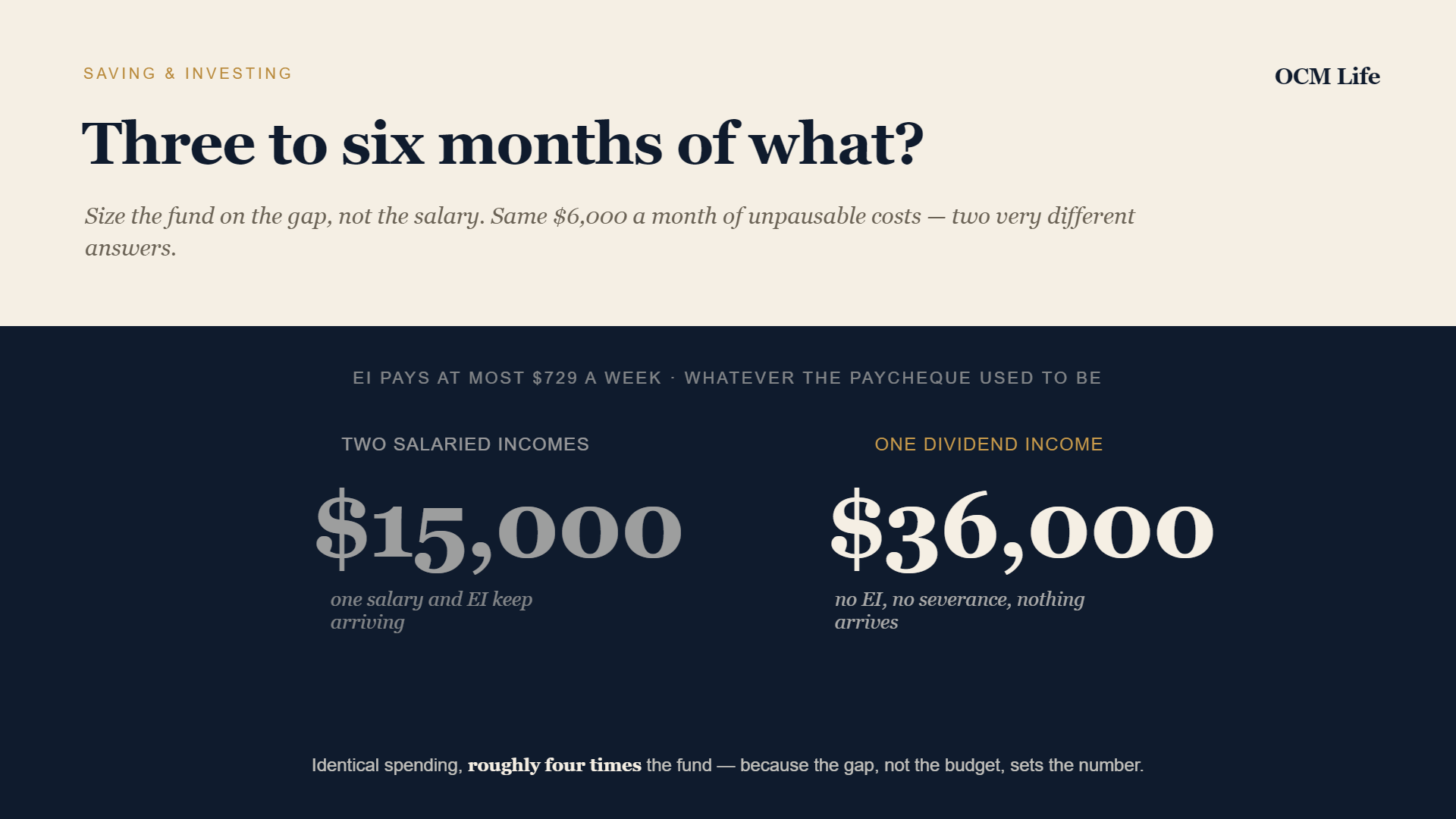
Picture two households, each spending $6,000 a month on things that cannot pause: housing, food, insurance, debt payments, childcare.
The first is a couple with two salaried jobs, $80,000 each. One job disappears. The other salary still delivers roughly $4,300 a month after tax, and EI adds about $2,900 more ($729 a week converted to a monthly figure, before tax). Arriving money roughly covers the $6,000 of leaving money; the fund exists for the waiting week, the deductibles, and the scenario where both jobs go at once. A fund in the range of $10,000 to $15,000 covers this household's realistic gap with room to spare.
The second is a single-income household run on dividends from an incorporated consulting practice. A lost major client means revenue drops toward zero, no EI, no severance, and client replacement cycles that run months. The gap is the full $6,000, and six months of it is $36,000. Nine months is $54,000. Same monthly spending as the first household, roughly four times the fund. The three-to-six-months rule, applied as written to both, would have left one over-saving and the other dangerously short.
The sizing arithmetic, in three steps
The calculation any household can run in twenty minutes: add up the monthly costs that cannot pause, subtract the money that would keep arriving in the likeliest bad scenario, and multiply the remainder by a month count that reflects how income actually fails in that household. Stable dual employment points to the low end. Single incomes, commission work, contract cycles, and corporate ownership point higher, sometimes well past six months. The output is a dollar figure, and a dollar figure is something a savings plan can hit; "three to six months" never was.
Where the fund lives matters too, since the whole point is money that is reachable in days without selling investments at a bad moment; that question has its own piece. And the fund has a ceiling as well as a floor: dollars past the sized target are dollars earning cash rates when they could be doing other work, which is a cost the default never mentions.
The question, restated
The "how many months" debate dissolves once it becomes "months of what." Not months of income, not months of a rule of thumb: months of the specific gap between what would keep arriving and what must keep leaving. Run the subtraction once and the right size stops being a debate and becomes a number.
This is general information, not advice. EI eligibility and benefit duration depend on individual work history and region; the household figures here are illustrative.
Sources
- Employment and Social Development Canada — EI maximum insurable earnings for 2026
- Government of Canada — EI regular benefits
Keep getting answers like this