Salary or dividends: the real trade-offs when you pay yourself from a corporation
The tax difference between salary and dividends is smaller than most owners expect. The real decision runs through three things dividends can't buy: RRSP room, CPP, and borrowing power.
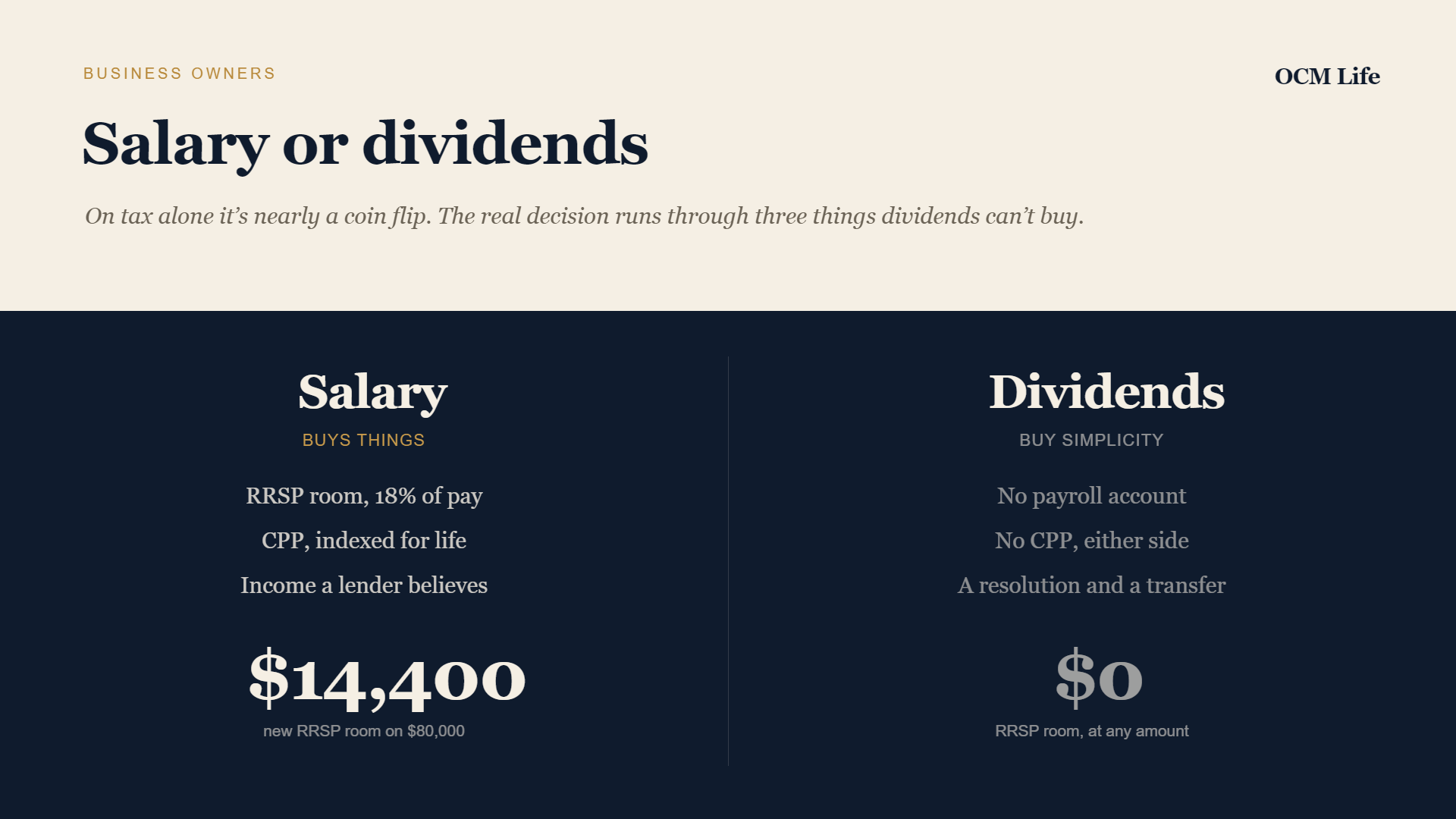
Salary or dividends? On tax alone, the answer is closer to a coin flip than either camp admits. The Canadian system is built on a principle called integration: income earned through a corporation and paid out to its owner is supposed to face roughly the same total tax as income earned directly, whichever route it takes. Integration is imperfect, and the gap shifts by province and year, but it is usually measured in fractions of a percentage point. Anyone choosing dividends purely to beat the tax on salary is optimizing a rounding error.
The real decision lives elsewhere. Salary and dividends are not two flavours of the same paycheque. They are different instruments that buy different things, and the differences compound over a career.
What a salary does
Salary is a deductible expense to the corporation, so it comes out of corporate income before corporate tax is calculated. It arrives on a T4, taxed at personal rates like any employment income. Along the way it does three things nothing else on this page does.
It builds RRSP room: 18% of earned income, up to the annual dollar limit, which is $33,810 for 2026 and $35,390 for 2027. Creating the full 2027 room takes $196,611 of salary in 2026. It builds Canada Pension Plan entitlement, an inflation-indexed pension backed by the federal government. And it reads as income to a lender, which matters the year a mortgage application asks for two years of T4s.
The costs are equally concrete. Payroll means a CRA payroll account, source deductions, and remittance deadlines. And the owner funds both halves of CPP: 5.95% from the employee side and 5.95% from the employer side on earnings between $3,500 and the year's maximum pensionable earnings of $74,600, plus a second layer, CPP2, of 4% per side on earnings between $74,600 and $85,000. At the top of both ranges that is $9,292.90 a year in combined contributions. Whether that figure is a cost or a purchase depends entirely on how much the buyer values a guaranteed pension.
What a dividend does
A dividend is paid from the corporation's after-tax profit. It is not deductible to the company, and the personal side compensates through a gross-up and dividend tax credit that account for the corporate tax already paid. That is integration doing its work. Dividends from income taxed at the small business rate arrive as non-eligible dividends; income taxed at the general corporate rate produces eligible dividends with a more generous credit. Paying the wrong type is a bookkeeping error with a real tax bill attached.
The appeal of dividends is simplicity and cash flow control. No payroll account, no source deductions, no CPP contributions on either side. A director's resolution and a transfer. For an owner whose corporation is also their long-term investment vehicle, skipping CPP keeps more capital inside the company to invest.
The cost is what dividends fail to build. Dividends create zero RRSP contribution room. They are not earned income and not pensionable earnings, so an owner drawing $300,000 a year entirely as dividends accumulates the same RRSP room and the same CPP entitlement as someone who earned nothing. A decade of that is a decade of contribution room that never existed and pension credits that were never bought. Lenders also discount dividend income more readily than T4 income, a difference that surfaces at exactly the wrong moment.
Side by side
| Salary | Dividends | |
|---|---|---|
| Deductible to the corporation | Yes | No (paid from after-tax profit) |
| Personal tax treatment | Employment income, full rates | Gross-up and dividend tax credit |
| RRSP room created | 18% of salary, to the annual cap | None |
| CPP | Both sides paid, entitlement built | No contributions, no entitlement |
| Administration | Payroll account, remittances, T4 | Director's resolution, T5 |
| Lender's view | Standard employment income | Often discounted or averaged |
The math on a real mix
Take an owner whose corporation clears $150,000 after expenses, and who takes $80,000 of it as salary. The salary is deductible, so corporate tax applies only to the remaining $70,000. Combined CPP on that salary runs about $8,893: $8,460.90 across both sides of the base contribution, plus $432 of CPP2 on the earnings between $74,600 and $80,000. In exchange, the year generates $14,400 of new RRSP room and a full year of pension credits at the maximum base level. Whatever the corporation pays out beyond the salary can flow as dividends, which is why the common structure is a blend rather than a purity test: enough salary to hit a chosen RRSP or CPP target, dividends for the rest.
One line for the owner who also holds a day job: a T4 employer is already deducting CPP, and while excess employee contributions come back at tax time, the employer-side contributions a corporation pays are never refunded. That single fact reshapes the math for anyone maxing CPP elsewhere.
The three questions that frame it
The salary-versus-dividends decision resolves into three questions, none of them about this year's tax bill. Does a guaranteed, indexed pension have a place in the retirement picture, or is the plan to self-fund entirely? Is the RRSP the intended savings vehicle, or is the corporation itself the long-term account, in which case room that never gets created may never be missed? And who is doing the payroll, because the administrative weight is real and recurring. A household where one spouse is incorporated has a further layer, since salary is also what funds a spousal RRSP, and the interplay between corporate savings and registered accounts runs through the compensation choice.
The precise split, this year, for one specific corporation, is a conversation for that corporation's accountant, because integration's small gaps move with province and rate changes. The framework does not move: salary buys RRSP room, CPP, and borrowing credibility at the price of payroll and contributions; dividends buy simplicity at the price of building nothing.
This is general information, not advice. Corporate compensation planning depends on province, corporate income level, and personal circumstances; the figures here are federal amounts for 2026.
Sources
- Canada Revenue Agency — CPP contribution rates and the CPP enhancement
- Canada Revenue Agency — RRSP dollar limits and the YMPE
Keep getting answers like this