How Canadian tax brackets actually work (and why a raise never costs you money)
The myth that earning more can push you into a higher bracket and leave you worse off refuses to die. Here's how Canada's tax brackets really work, marginal versus average, federal plus provincial, in plain numbers.
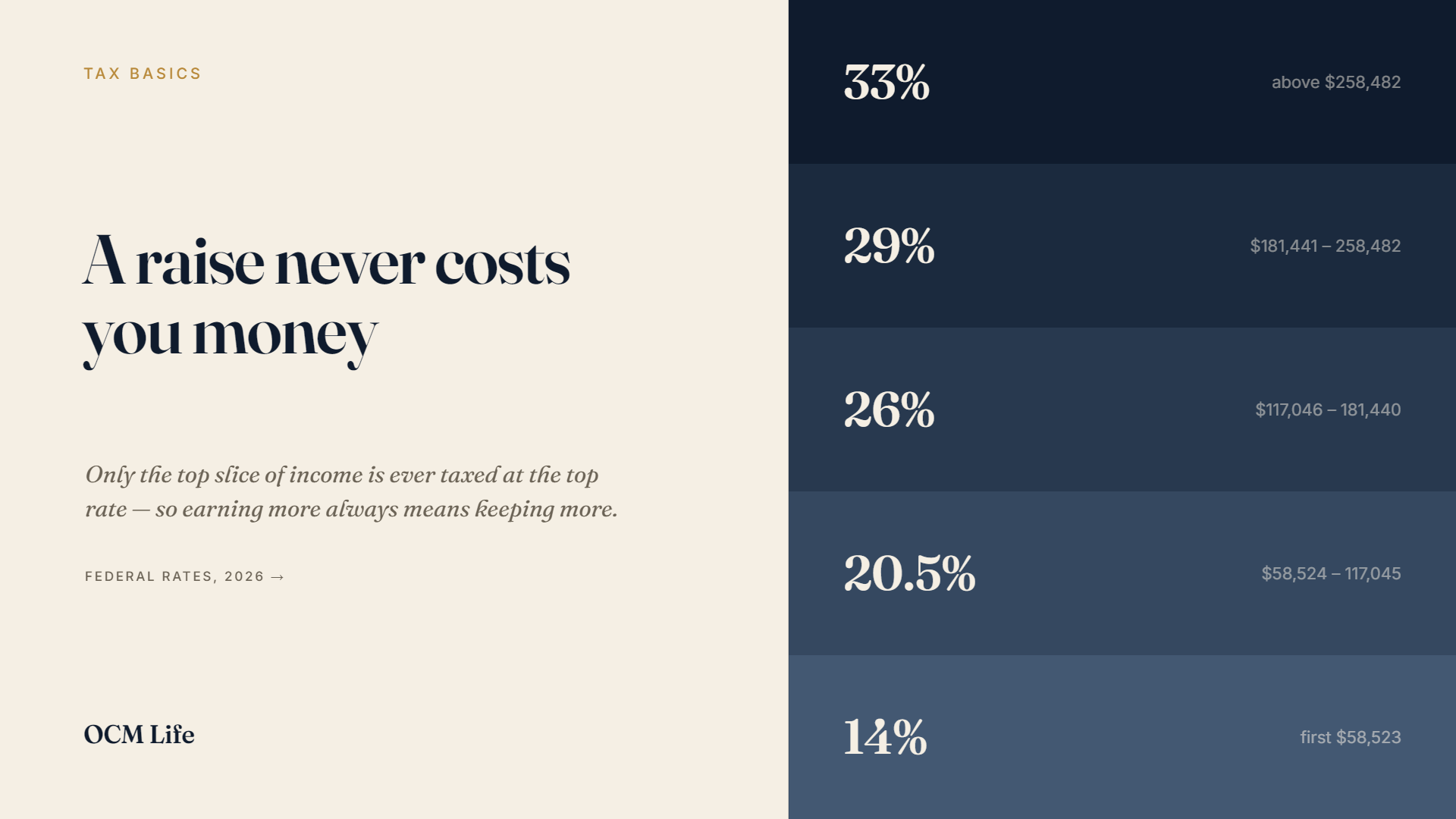
The most persistent myth in Canadian personal finance refuses to die: that a raise can bump you into a higher bracket and leave you worse off. It can't. It is not possible to earn more, cross into a higher tax bracket, and end up with less money in your pocket. Anyone who tells you otherwise has misunderstood the system, and the misunderstanding is common enough to be worth fixing properly.
Brackets are marginal: only the top slice is taxed at the top rate
Canada taxes income in layers. Each bracket has a rate, and that rate applies only to the dollars that fall inside that bracket, not to your whole income. Move into a higher bracket and only the dollars above the line are taxed at the higher rate. Every dollar below it keeps being taxed exactly as before.
Picture filling a glass with bands of colour. The first band fills at the lowest rate. When income rises past a threshold, the next band fills at the next rate up, but it doesn't recolour the bands beneath it.
The federal brackets for 2026:
| Taxable income (2026) | Federal rate on income in this band |
|---|---|
| Up to $58,523 | 14% |
| $58,524 to $117,045 | 20.5% |
| $117,046 to $181,440 | 26% |
| $181,441 to $258,482 | 29% |
| Over $258,482 | 33% |
(The lowest rate dropped from 15% to 14% in 2025, so this is one to check against the exact year you're filing.)
A worked example
Take someone earning $70,000 who just got a raise and is half-worried it pushed them somewhere worse. People often assume $70,000 lands them "in the 20.5% bracket," taxed 20.5% on every dollar. It doesn't.
- The first $58,523 is taxed at 14% → about $8,193.
- The remaining $11,477, the part above the threshold, is taxed at 20.5% → about $2,353.
- Federal tax on the brackets: roughly $10,546, before the basic personal amount credit below, which lowers it further.
Notice what happened. Even though this person reaches the 20.5% bracket, only a slice of their income is actually taxed at 20.5%. The rest sits in the 14% band. (This is the federal layer only; provincial tax, further down, adds to it.)
Marginal rate vs average rate: the two numbers people mix up
Two different rates describe your taxes, and confusing them is what feeds the myth.
Your marginal rate is the rate on your next dollar of income, 20.5% federally for the person above. It's the number that matters when you're weighing a raise, some overtime, or a Registered Retirement Savings Plan (RRSP) deduction, because it tells you how the next dollar (or the next deduction) is treated.
Your average rate is your total tax divided by your total income. For the $70,000 earner, roughly $10,546 on $70,000 is about 15%, and lower still once the personal-amount credit is applied. Either way it's well below their 20.5% marginal rate. In a layered system the average is always below the marginal, because most of your income is taxed in the lower bands. So when someone says "I'm in the 20.5% bracket," they almost never mean they pay 20.5% of everything. They don't.
Your marginal rate is the rate on your next dollar. Your average rate is what you actually pay. They are never the same number.
The income that's tax-free
Before any of this, there's the basic personal amount, a slice of income every resident can earn free of federal tax. For 2026 it's up to $16,452 (it tapers down for high earners, to a floor of $14,829). It works as a credit, but the effect is simple: the first chunk of what you earn carries no federal tax. It's why a part-time or lower-income earner can owe little or no federal income tax at all.
Then the provinces stack on top
Everything so far is the federal layer. Your province or territory then applies its own brackets and rates on top, with its own thresholds, which don't line up with the federal ones.
In Alberta, for example, the 2026 provincial rate is 8% on the first $61,200 of taxable income, then 10% up to $154,259, before climbing further. So an Albertan's true marginal rate is the federal rate plus the provincial rate at their income, the two layers added together. Every province sets its own, which is why "what's the tax rate in Canada" has no single answer: it depends on where you live as much as what you earn. (Which province's rates apply is set by where you're resident on December 31.)
Why this is worth understanding
Two practical payoffs.
First, the myth is dead. A raise, a bonus, or a side income always leaves you with more after tax than before. You may keep a smaller share of the dollars that cross into a higher band, but you keep some of every dollar. Earning more never nets out negative.
Second, knowing your marginal rate is the key that unlocks the rest of your money decisions. It's the number that tells you what an RRSP or First Home Savings Account (FHSA) deduction is actually worth to you. Deduct $1,000 at a 30% combined marginal rate and you save $300 (the logic behind RRSP vs TFSA and the FHSA). It's also why deductions and credits aren't the same thing: a deduction lowers your taxable income, so it's worth your marginal rate; most credits lower your tax bill directly at the lowest rate. Same dollar amount, different value, depending on which one it is. (If you're paid in dividends rather than salary, the rate that applies works differently again, through the dividend tax credit, which is its own piece.)
The one sentence to keep
Only the income inside a bracket is taxed at that bracket's rate, so earning more always means keeping more, and your real "tax rate" is lower than the bracket you're in suggests.
This is general information, not advice. Tax brackets, the basic personal amount, and provincial rates are indexed and change yearly; the figures here are for 2026. Always check the current year's numbers before relying on them.
Sources
- Canada Revenue Agency — Canadian income tax rates for individuals
- Government of Alberta — Personal income tax
Keep getting answers like this