Married money: how the CRA actually sees couples
Canada taxes individuals, not households, and that single fact explains most of what changes (and doesn't) when you marry. The attribution rules, the TFSA exception, and how a spousal RRSP moves income from one return to the other.
You got married in August. The paycheques look the same in September, the tax withheld looks the same, and come spring you will still file your own return, because Canada has no joint filing. It is reasonable to conclude that marriage changed nothing about your taxes. It changed several things, and the ones that matter most are the ones nobody mentions at the wedding.
The starting fact that explains everything else: the Canadian tax system assesses individuals, not households. Two returns, two sets of brackets, two sets of contribution room. Almost every couples' strategy in Canadian personal finance is a workaround for that design, and almost every trap is a rule built to stop the workarounds from going too far.
What actually changes at "married"
Marital status is not optional information. Married, and common-law after twelve months of living together, must be reported, and the CRA treats the two identically. From that point, several calculations switch from individual income to family income: the GST/HST credit, the Canada Child Benefit, and other income-tested benefits are all assessed on the combined number. A couple where each partner qualified for a credit alone may find the household qualifies for less together. That is the unadvertised cost of the status change.
The benefits run the other way through credits. A spouse earning little or nothing generates the spousal amount, a credit that reduces the higher earner's tax. Several other credits, tuition among them, can transfer between returns when one partner cannot use them. And some planning tools unlock entirely, the spousal RRSP chief among them.
The rule that polices everything: attribution
Since the system taxes individuals, an obvious move suggests itself to any couple with one high earner: hand investment money to the lower-income spouse, let the returns land on the return taxed at a lower rate. The Income Tax Act anticipated this decades ago. When one spouse gifts money to the other to invest in an ordinary taxable account, the income and capital gains are attributed back to the giver and taxed on the giver's return, as if the transfer never happened.
The exceptions are where the actual planning lives. The cleanest one is the TFSA: money gifted to a spouse and contributed to that spouse's own TFSA generates no attribution while it stays in the account, because there is nothing to attribute; the growth is tax free regardless. A high earner topping up a partner's unused TFSA room is the simplest legal income shift in the system. The second exception has its own name.
The spousal RRSP, mechanically
A spousal RRSP is an account owned by one spouse, the annuitant, and funded by the other, the contributor. The design splits the two halves of an RRSP between two people. The contribution uses the contributor's room and produces the contributor's deduction, but the eventual withdrawal is taxed on the annuitant's return. Deduct at a high rate today, withdraw at a low rate later, on a different person's return: that is the entire machine.
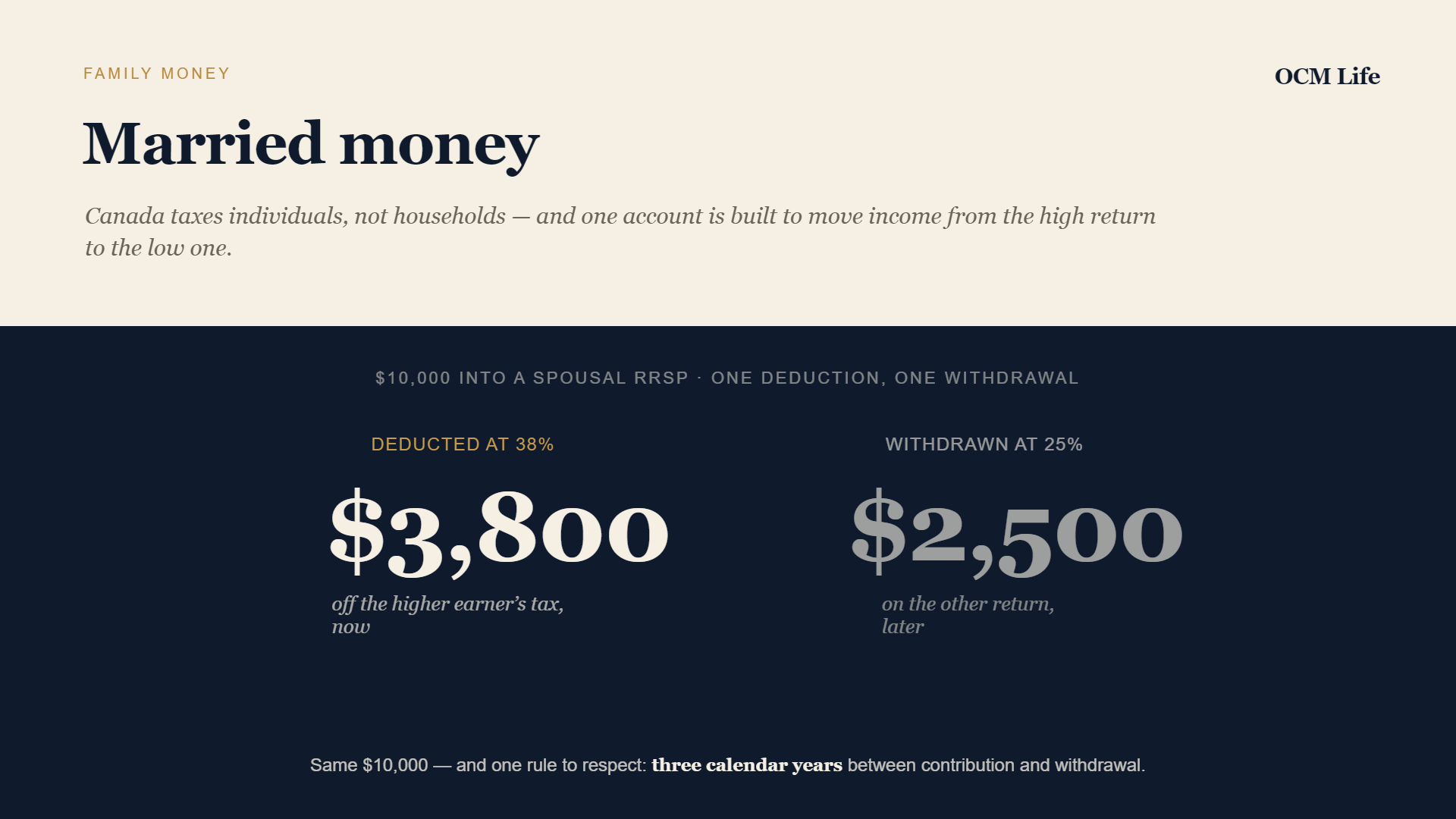
Take a couple in their thirties, one earning $120,000 and one earning $40,000, and suppose they expect that gap to persist into retirement. The higher earner contributes $10,000 to a spousal RRSP. At a marginal rate around 38%, the deduction cuts that year's tax by roughly $3,800. Decades later, the lower-income spouse draws that money at a marginal rate closer to 25%, paying about $2,500 on the same $10,000. The couple kept the difference, and more importantly, retirement income now arrives split across two returns and two sets of brackets instead of piling onto one.
Since 2007, couples have also been able to split eligible pension income, including RRIF withdrawals from age 65, directly on their tax returns, shifting up to half of it to the other spouse. That rule took over some of the spousal RRSP's old job. What it did not take over: income splitting before 65, contributions past 71 for someone with a younger spouse, and the simple value of two balanced accounts instead of one large and one empty.
The three-year clock
The rule that catches couples is attribution's last stand inside the spousal RRSP. If the annuitant withdraws money in the same calendar year as a spousal contribution or in the two calendar years after it, the withdrawal is taxed back to the contributor, up to the amount of those recent contributions. The clock runs on calendar years, which produces a subtlety worth knowing: a contribution made in December starts its clock a full year earlier than one made the following January, even though both can be deducted on the same return. Couples planning an early withdrawal window sometimes move a planned February contribution back to December for exactly that reason.
The clock also applies per account, not per contribution, in one practical sense: merging a spouse's personal RRSP into the spousal account makes the entire balance subject to the rule, which is why the two are often kept separate.
The pattern most couples land on
Among couples with a wide and durable income gap, a familiar sequence shows up. Each spouse fills their own TFSA, with the higher earner gifting funds for the other's room, since no rule stands in the way. RRSP dollars flow to whichever mix evens out the two retirement incomes, which often means the higher earner directing some or all contributions to a spousal plan. And any withdrawal plans keep three calendar years of distance from the last spousal contribution. Households where one partner is incorporated add a layer, because only salary creates the RRSP room this whole structure runs on; the mechanics are in our piece on paying yourself from a corporation, and the underlying account choice is covered in RRSP vs TFSA.
None of that is a prescription; it is what the rules reward when two incomes differ. When they do not, the spousal RRSP mostly sits unused, and that is the system working too.
This is general information, not advice. Marginal rates in the example are illustrative and vary by province and income; how any of this applies to a specific couple depends on their numbers.
Sources
- Canada Revenue Agency — Contributing to your spouse's or common-law partner's RRSPs
- Canada Revenue Agency — Pension income splitting
Keep getting answers like this