The 2026 renewal wave: why a million mortgages are resetting this summer
Roughly 1.15 million Canadian mortgages come up for renewal this year, most of them signed at the record-low rates of 2021. What's actually happening, how a renewal works, and what the reset looks like in real dollars.
There's a big wave of mortgage renewals moving through Canada this summer, and it's not an accident of the calendar. Most Canadian mortgages run on five-year terms, and five years ago rates were at the lowest levels ever recorded. The people who signed then are the people renewing now.
Where the wave came from
Go back to 2021. The Bank of Canada had cut its policy rate to 0.25%, an all-time low, and held it there through the pandemic, and central banks everywhere had done the same. Mortgage money had never been cheaper: five-year fixed rates fell to the 1% to 2% range, and five-year variable rates dropped as low as 0.88% late that year, the cheapest borrowing in Canadian mortgage history.
A record number of Canadians bought or refinanced at those rates. On the standard five-year term, that cohort's mortgages all come due on roughly the same schedule, and mid-2026 is where the calendar lands. Renewal volumes actually peaked in 2025 and are easing through this year, but the numbers are still enormous: about 1.15 million mortgages renew in 2026, and the Bank of Canada estimates roughly 60% of all outstanding Canadian mortgages renew across 2025 and 2026 combined.
The rate you leave, and the rate you meet
Here's the part that matters at the kitchen table. A mortgage locked in around 2% in 2021 meets a renewal rate close to twice as high. As of early July 2026, the lowest advertised five-year fixed rates sit just under 4% (3.94% as of July 2), with the Bank of Canada's policy rate holding at 2.25% since October 2025. Renewal offers typically land somewhat above the lowest advertised rate, which is why the example below uses 4.1%.
Doubling the rate does not double the payment, since a large share of each payment is principal coming back to the borrower, but it moves it a lot. Which is where a worked example earns its keep.
What renewal looks like in real dollars
Take a household that bought in the summer of 2021: a home near the national average price, a down payment, and a $550,000 mortgage at a 2.0% five-year fixed rate on a 25-year amortization. (For scale, the national average home price sits at $702,079 as of May 2026.)
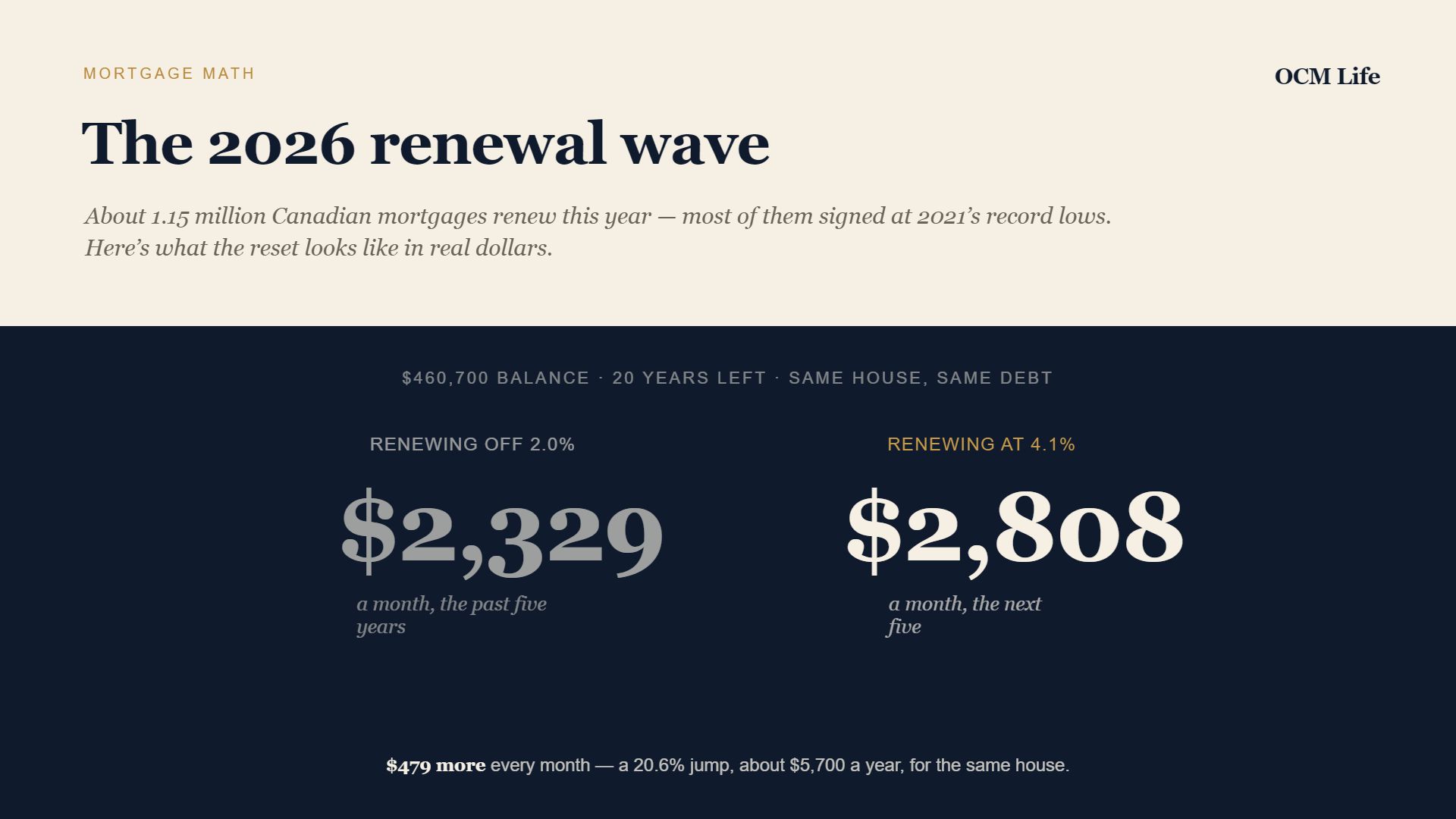
Their payment for the past five years: about $2,329 a month.
Now, one thing about those five years of payments: interest is front-loaded, and principal gets paid off later. In the early years of a mortgage, a bigger share of each payment goes to interest, because the balance it's charged on is at its largest. Even so, at a 2% rate the split is friendlier than most people expect: after 60 payments, this household has paid off about $89,000 of principal and paid about $50,000 in interest, leaving a balance of roughly $460,700 at renewal.
Renew that balance at 4.1% over the remaining 20 years and the payment becomes about $2,808 a month.
That's $479 more every month: a 20.6% jump, or about $5,700 a year, for the same house, the same remaining debt, the same amortization schedule. It isn't a stretch case; the Bank of Canada's own analysis puts the average payment increase for five-year fixed borrowers renewing in 2026 at roughly 20%. Some households will see less, especially those who renewed shorter terms along the way or made prepayments. Some, notably variable-rate borrowers with fixed payments, will see considerably more.
And the payment is only half the picture. Over the next five-year term, this household will pay about $85,700 in interest at 4.1%. Had the 2% rate somehow carried on, the same five years would have cost about $41,100. The rate reset alone adds roughly $44,500 in interest over one term: money that buys nothing new, on a debt that already existed.
Interest is front-loaded, and principal gets paid off later. The balance you renew is bigger than most people guess, and so is what the new rate does to it.
How the renewal itself works
A renewal is not a new mortgage application in the full sense. Near the end of the term (typically a few weeks out, though lenders can start the conversation months earlier), the current lender sends a renewal offer letter with new rates for various terms. Signing it continues the mortgage with no requalification.
That convenience is worth understanding, because it cuts both ways. Staying put is easy; moving the mortgage to another lender at renewal is also possible, generally without penalty when it's done at the end of the term, though it can involve requalifying with the new lender. The renewal moment is also when the structural choices reopen: fixed or variable, the length of the next term, and in some cases the amortization. Each of those is its own trade-off, and the fixed-versus-variable decision at renewal is a piece of its own.
What it means, and what it doesn't
For most people renewing this year, the impact is real and the direction is one way: housing is most people's single biggest expense, and the interest rate on it is the one input nobody gets to control. A payment increase in the hundreds of dollars a month lands on a budget that has already been through four years of inflation, and it's the kind of shift that puts new pressure on the household cushion (where to keep your cash covers that side of the ledger).
What the wave is not, so far, is a crisis. Canada Mortgage and Housing Corporation (CMHC) data shows most renewing households absorbing the higher payments: the national rate of mortgages more than 90 days behind sits at 0.24% as of late 2025 (up from 0.21% a year earlier, and still below pre-pandemic levels), with the stress concentrated in Toronto and Vancouver rather than spread across the country. Many households have managed it by extending amortizations to shrink the monthly hit, which lowers the payment and raises the lifetime interest. A trade-off, not a free lunch.
The handback
Whether this summer's renewal is a bump or a wall comes down to numbers only the household holds: the balance being renewed, the gap between the old rate and the offers actually available, and how much room the monthly budget has to give. The arithmetic above is how to run your own version. The rate environment is the part nobody chooses, but the term, the lender, and the structure of the next five years are still decisions, and they belong to the person signing.
This is general information, not advice. Rates and figures here are as of early July 2026 and move constantly; check the live numbers, and your own renewal letter, before relying on them.
Sources
- Canada Mortgage and Housing Corporation — Residential Mortgage Industry Report, Spring 2026 (renewal volumes, arrears)
- Bank of Canada — policy interest rate (0.25% through the pandemic; 2.25% as of July 2026)
- WOWA — Canada mortgage rates history (2021 record lows) and current best mortgage rates
- Canadian Real Estate Association — national average home price, May 2026
Keep getting answers like this