Canada has no inheritance tax. Your estate can still owe six figures.
The most repeated line in Canadian estate conversation is true and misleading at once. There's no inheritance tax, but death is still a tax event: a deemed sale of everything, a final return, and a provincial fee on top. Here's how the bill is actually calculated, and what escapes it.
One of the most repeated lines in Canadian money conversation is entirely true: Canada has no inheritance tax. No estate tax either, nothing like the American system where the estate itself is taxed above a threshold before heirs see a dollar. The line survives because it is accurate. It misleads because of what it leaves out. Death, in Canada, is still a tax event, and for many estates it is the largest single tax bill of the person's life. The bill just wears a different name.
Why the myth persists
The comparison is always to the United States, where "estate tax" and "death tax" are political vocabulary. Canada abolished its federal estate tax in 1972 and replaced it with something less visible and often more expensive: the deemed disposition. Because no line on any form says "inheritance tax," the system reads as free. It is deferred, which is a different thing.
How it actually works: the deemed disposition
At death, the tax system treats a person as having sold everything they own at fair market value, the moment before they died. No sale happens. The cottage stays a cottage, the portfolio stays a portfolio. But every unrealized capital gain accumulated over a lifetime becomes realized at once, and it all lands on one document: the terminal return, the final personal tax return filed for the year of death.
Registered accounts are treated more harshly still. An RRSP or RRIF is not deemed sold for capital gains; its entire value is added to the terminal return as ordinary income, exactly as if the person had withdrawn every dollar on their last day. The whole balance, not just the growth, because RRSP money was never taxed going in: the deduction at contribution was a deferral, not a discount, and there is no cost base in an account funded with pre-tax dollars. A $400,000 RRIF alone can push a final return deep into the top brackets. Decades of untaxed income land in a single year, at the highest rates the person ever faced.
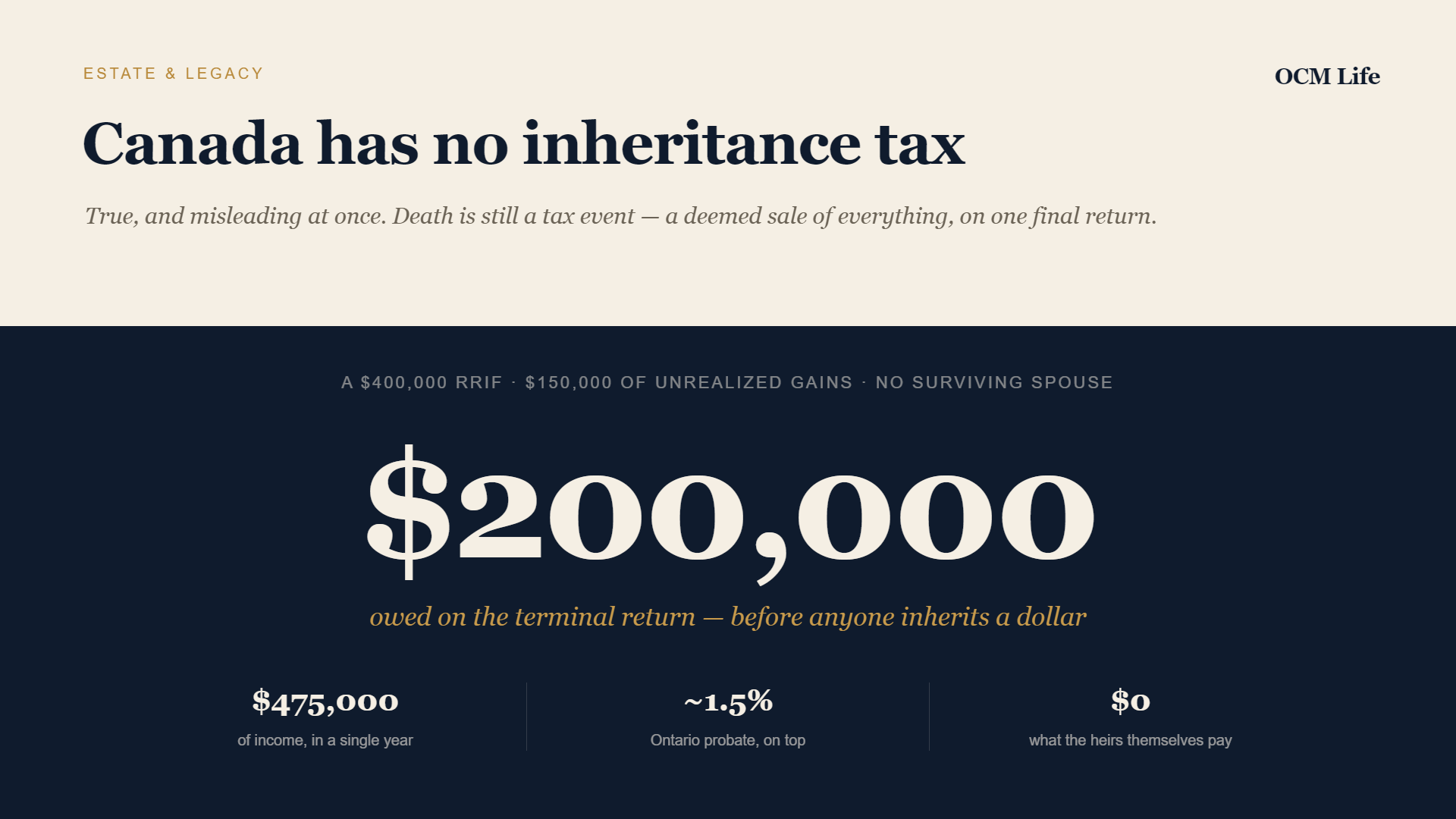
Run a rough version. Someone dies unmarried with a $400,000 RRIF, a home, and a taxable portfolio carrying $150,000 of unrealized gains. The RRIF adds $400,000 of income to the terminal return. The portfolio's deemed sale adds $75,000 more, since half of a capital gain is taxable at the current 50% inclusion rate. Call it $475,000 of income in one year. At 2026 combined federal and provincial rates the bill runs from roughly $185,000 in Alberta, the lowest-rate province, to about $215,000 at the high end; call it $200,000 for a typical estate, most of it calculated in the top bracket. The estate pays it before anyone inherits anything.
What escapes the bill
Four large exemptions do most of the sheltering in Canadian estates, and knowing them is knowing where the planning happens.
The principal residence exemption carries through death: a home that qualified as a principal residence throughout ownership passes with its gain untaxed, which is why the house is usually the least of an estate's tax problems. The TFSA arrives tax free by design, and a spouse named as successor holder simply becomes the new owner of the account, intact and still sheltered. Life insurance pays its death benefit tax free to a named beneficiary. And the largest of them all is the spousal rollover: anything left to a surviving spouse or common-law partner, including the full RRSP or RRIF, transfers at cost with no deemed disposition and no income inclusion. The entire bill defers until the survivor sells, withdraws, or dies.
Canada doesn't tax inheritance. It taxes the person who died, one last time.
The rollover is the reason the first death in a married couple usually costs little. It is also the reason the second death costs so much: two lifetimes of deferral end on one terminal return. Estates are planned around the second death, not the first.
The second layer: probate
Separate from income tax entirely, most provinces charge a fee to validate a will and confirm the executor's authority. The spread is wide. Ontario's estate administration tax runs $15 per $1,000 of estate value above $50,000, about 1.5%, so a $1 million estate pays roughly $14,250. British Columbia sits in similar territory. Alberta charges flat court fees capped in the hundreds of dollars regardless of estate size, and Quebec charges next to nothing when the will is notarial. Probate applies only to assets flowing through the will, which is why named beneficiaries on registered accounts and insurance, successor holder designations on TFSAs, and jointly held property with a spouse all bypass it. On large estates in high-fee provinces, the difference between a designated beneficiary and a blank form is measured in thousands.
What the heirs actually receive
Beneficiaries in Canada inherit tax free. The estate settles the terminal return, pays probate, obtains a clearance certificate from the CRA confirming nothing further is owed, and distributes what remains. An heir does not report an inheritance as income. What an heir receives has simply already been taxed, upstream, on someone else's final return. The occasional ugly surprise happens when a registered account names one beneficiary directly while the terminal tax bill falls on the estate and everyone else's share; the account bypasses probate, the tax does not bypass the estate.
Where wills, executors, and powers of attorney are concerned, the law is provincial and the documents are a lawyer's work, not a blog's. The tax mechanics above are federal and universal, and they connect to accounts covered elsewhere: the successor holder rules make the TFSA the cleanest asset to die holding, and everything about the spousal rollover builds on how the system treats couples while both are alive.
The principle to keep
The tax bill at death belongs to the person who died, not to the people who inherit. Deferral is the engine of Canadian retirement accounts, and death is where deferral ends; for a couple, it ends at the second death, all at once, on one return. An estate plan is mostly a plan for that one document.
This is general information, not advice. Estate outcomes depend on province, family structure, and asset mix, and the rates in the example are illustrative; wills and estate documents require a lawyer licensed in the relevant province.
Sources
- Canada Revenue Agency — Doing taxes for someone who died
- Government of Ontario — Estate Administration Tax
Keep getting answers like this