The fee you can't see: how an MER works, and what 2% really costs
Most Canadian mutual funds charge close to 2% a year, deducted before you ever see a return. Here's what that fee is made of, what it costs over a career, and how to find what you're paying.
Pull up your most recent investment statement and try to find the fee you paid last year. If you hold the kind of mutual fund most Canadians hold, you can't. The balance is there and the returns are there, but the fee that came out of them sits nowhere on the page. It was deducted inside the fund before your return was ever reported, so the money left without a line, an entry, or anything to react to. That is the main reason a charge most people would flinch at, if they ever saw it, has gone unquestioned for years.
That is about to change. Starting with statements for the 2026 calendar year, which arrive in early 2027, Canadian investors will be shown the actual dollar amount they paid in fund fees, not just a percentage buried in a document almost nobody opens. The number is the same one that has always been leaving the account. The only difference is that you will finally see it. So this is a good time to understand what it is made of.
What the 2% actually buys
Most mutual funds sold in Canada carry a management expense ratio, the MER, of close to 2% a year. Morningstar's recurring study of global fund costs puts the median Canadian equity fund near 1.98% and the median balanced fund around 1.94%, among the highest of the 26 countries it measures. Broad-market index funds and exchange-traded funds that simply track the market often charge a small fraction of that, frequently between 0.05% and 0.25%.
The MER is not a single fee. It bundles the management fee paid to the people running the portfolio, the fund's operating costs (administration, legal, audit, custody, recordkeeping, and the sales tax on all of it), and, in the commission-based version of a fund, a trailing commission paid to the advisor's firm for selling and servicing it. That last piece, the trailer, typically runs between 0.5% and 1.5%, and it is the main reason an advice-sold bank fund costs roughly a percentage point more than a comparable index product.
However the fee is split up, the mechanism is identical. The MER is calculated daily and taken from the fund's value before any performance is reported, which is why the return printed on your statement is already net of it. A fund that earns 7% gross and charges a 2% MER reports 5% to you. It comes out every year, win or lose, whether the fund beats its benchmark or badly trails it. You are paying it right now, and you have most likely never seen a bill.
Two percent, over twenty-five years
A single percentage point sounds negligible. Compounded across a few decades and applied to a growing balance, it becomes one of the largest controllable factors in what you end up with.
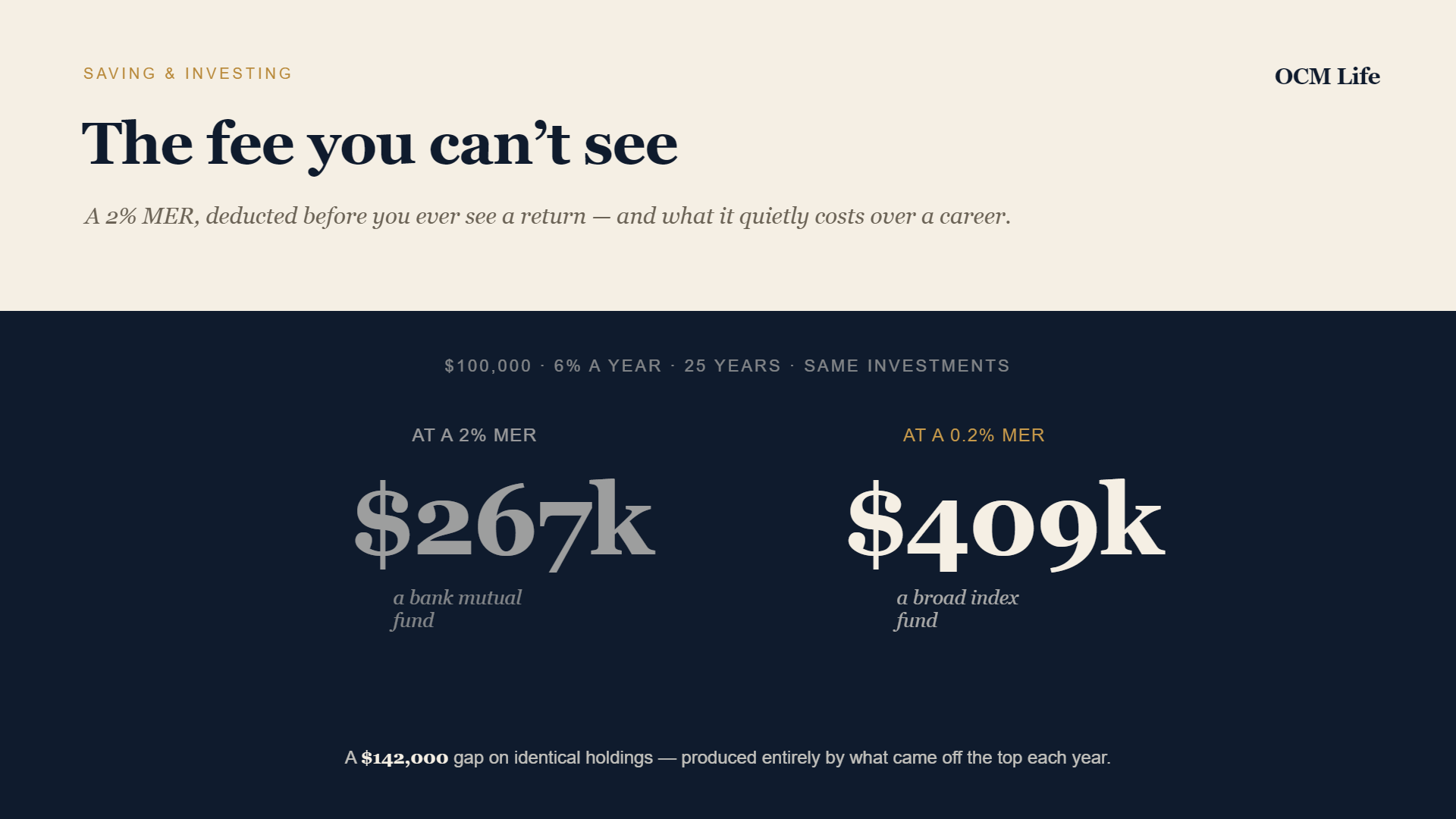
Take someone who is 35, with $100,000 already invested in a couple of bank mutual funds, planning to leave it untouched until 60. Assume the holdings earn 6% a year before fees. At a 2% MER, the balance grows to roughly $267,000 over those 25 years. At a 0.2% MER, the same holdings earning the same 6% reach roughly $409,000. Same money, same market, same investments: a gap of about $142,000, produced entirely by what came off the top each year. Change the return you assume and the dollar figure moves with it, but the shape holds. Morningstar estimates that a 2% fee erodes close to a third of an investor's wealth over a couple of decades, which is what the arithmetic shows here. The higher-fee version finishes with roughly a third less, on identical investments.
This is not a story about a bad fund manager. Both investors could hold the very same stocks. The whole of the difference is the fee.
A fee you can't see is a fee you don't question.
What the headline number hides
Two things the MER does not advertise.
First, part of it may be buying you something real. In an advice-sold fund, the trailer inside your MER is meant to pay for an advisor's ongoing service: a financial plan, periodic rebalancing, a steady hand to talk you out of selling at the bottom. If you receive that and you value it, the fee is the price of a service, and a fair one to weigh against the alternatives. If you bought the fund yourself through a discount brokerage and have never spoken to anyone, that same trailer is buying you nothing. Regulators drew exactly that line in 2022, banning trailing commissions on self-directed brokerage accounts and ending new sales of deferred sales charge funds across the country. The question the rule hands you is plain: are you paying for advice you actually receive?
Second, the MER is not quite the entire cost. On top of it sits the trading expense ratio, the cost of the fund buying and selling inside its own portfolio. The two together are now called the fund expense ratio, and it is that combined figure the new 2026 reporting will put in front of you. For most plain-vanilla funds the trading layer is small, but it is real, and it is one more cost that left before your return was posted.
How to find what you're paying
The fee has been disclosed all along, just not anywhere you would naturally look. Four places hold the answer.
Your statement carries a fund code, something like RBF460 or TDB900. Type it into Morningstar.ca and the MER is listed under fees and expenses. Every fund also publishes a short Fund Facts document that states the MER as a percentage and, more usefully, as a dollar cost for every $1,000 invested. Your annual Report on Charges and Other Compensation already shows what your dealer was paid, though until now it has left out the fund's own management fee. And the most direct route of all is to ask whoever sold you the fund what you are paying, all in, and what it has returned after costs.
From the 2026 tax year, you will not have to go looking. Under new total cost reporting rules from the Canadian Securities Administrators, in effect January 1, 2026, every dealer must show the dollar amount of fund fees you paid that year, fund by fund and as a single total, in the annual report that arrives in early 2027. It is the logical next step from the 2016 reforms that first put trailer fees in dollar terms, and it finally closes the gap those reforms left open: the embedded MER itself. The figure has always existed. For the first time, it will have your name on it.
The question worth asking
The useful question was never "index or active," and it is certainly not a push to go sell anything. It is narrower, and you can answer it this week. Do you know what you are paying on what you already own, and is that fee buying something, either performance after costs or advice you use, that you could not get for less?
A 2% all-in cost that includes a financial plan you rely on is a different proposition from 2% for a fund you picked yourself and never think about again. Lower is not automatically better. What you get for the fee is the entire point. And the same drag applies inside a TFSA or RRSP, an RESP, or a corporate investment account, so the answer is worth having wherever your money sits. The account wrapper changes the tax, not the MER.
One thing sets this apart from almost every other money decision. You cannot control what the market returns, or whether any particular fund beats it. You can control, precisely and starting today, what you pay to be in the game at all. It is the rare lever that is entirely yours to pull, and the only thing that has stood between most people and pulling it is a number they could not see. That number is about to appear on the statement. Be ready to read it.
This is general information, not advice. The fees here are illustrative, and what you actually pay depends on the specific funds you hold; the steps above are how to find your own number.
Sources
- Canadian Securities Administrators — Total Cost Reporting enhancements for investment funds
- Canadian Investment Regulatory Organization — Enhanced Cost Reporting
- Morningstar — What is the MER for fund and ETF investors?
Keep getting answers like this