When a credit card's annual fee is actually worth it
A rewards card with a $120 fee can be a bargain or a waste of money, and the deciding factor is mostly arithmetic. Here's the break-even math, plus the one rule that makes any rewards card pointless if you ignore it.
You're looking at a card with a $399 fee and a wall of "premium" perks, trying to work out whether it pays for itself or just pays the bank. Before any of that, one rule settles half the question: a rewards card only makes sense if you pay your balance in full every month. As of 2026, Canadian cards charge interest of roughly 20%, typically 19.99% to 24.99%. At that rate, the interest on a carried balance dwarfs any 1% or 2% in rewards. Earning 2% back while paying 20% to borrow is a losing trade, every time.
So this piece assumes you clear your balance each month. If you carry one, the rewards rate is beside the point, and the only number that matters is the interest rate.
With that settled, the annual-fee question is just math.
The break-even, in one calculation
A fee card is worth it only when the extra rewards it earns over a free card beat the fee. That comparison, not the headline rewards rate, is the whole game.
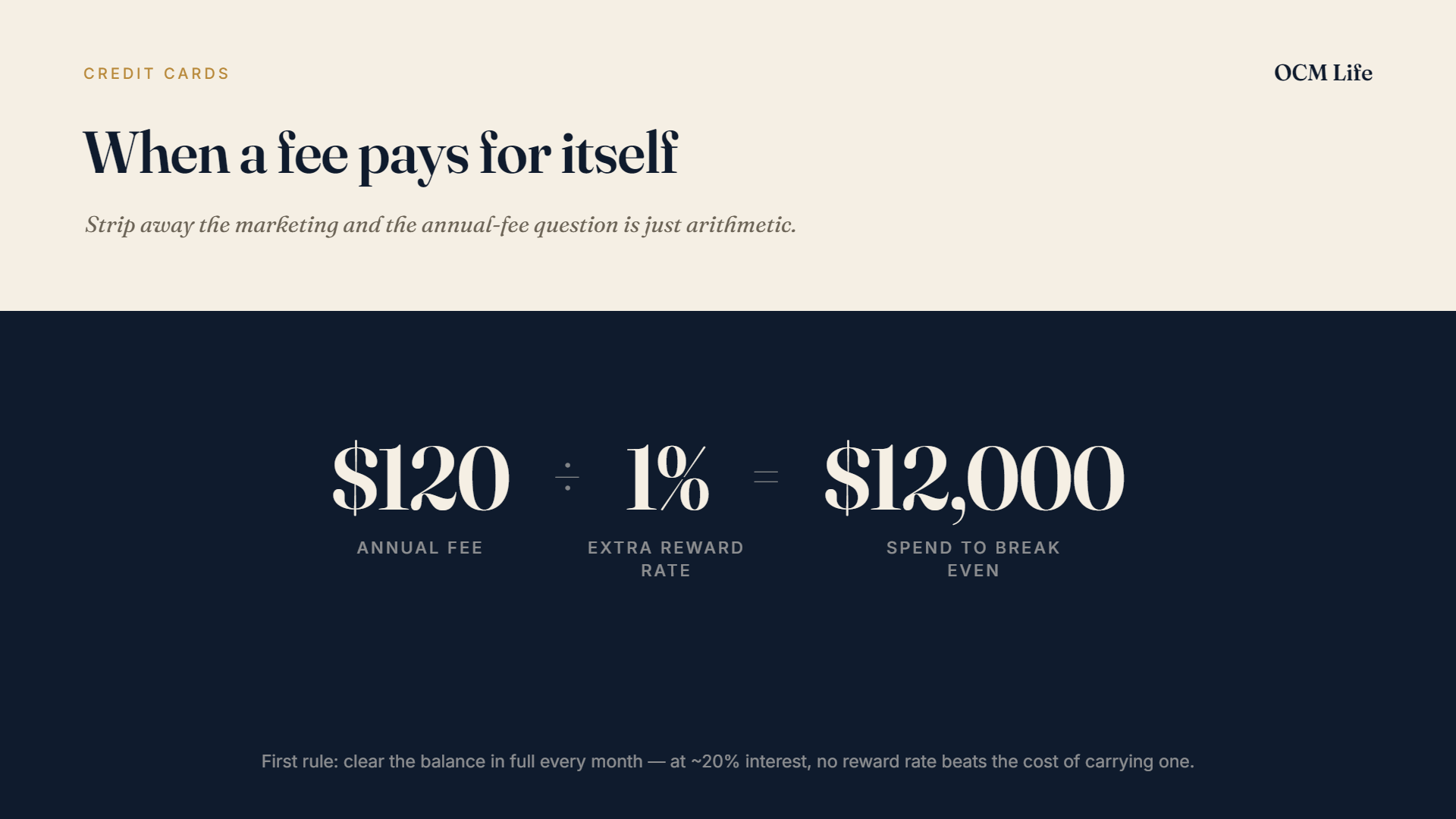
Say a card charges a $120 annual fee and earns 2% back. A no-fee card earns 1% on the same spending. The fee card's real advantage is the extra 1%. To cover the $120 fee with that extra 1%, you'd have to spend $12,000 a year on the card ($120 ÷ 0.01). Below that, the no-fee card comes out ahead; above it, the fee card does.
So the question isn't "is 2% a good rate?" It's "do I spend enough for the extra rewards to clear the fee?" The calculation works for any card: divide the annual fee by the extra rewards rate over the free alternative, and that's the yearly spend where the fee starts paying for itself.
The same math humbles premium cards fast. A $399 card earning, say, 1.5% more than a free card needs roughly $26,600 of annual spending just to break even on the fee, before it has earned a single dollar. A premium fee demands premium spending to justify itself.
The benefits that can change the math
The rewards rate isn't the only thing a fee buys. Some cards bundle perks with real cash value: travel medical insurance, rental-car coverage, airport lounge access, a free checked bag, an annual companion flight. The test is whether you'd actually use them, and whether you'd otherwise have paid for them.
If a $150 card includes travel medical insurance you'd have bought anyway for $120, most of the fee is covered before rewards enter the picture. If it includes lounge access you'll use often, fine. But perks you'll never touch are worth zero to you, whatever the marketing says. Value the perks you'd use; count the rest as nothing.
The headline rewards rate sells the card. The fee, your real spending, and the perks you'll use decide whether it's worth carrying.
The costs that dwarf the fee
A few things the rates and rewards don't advertise, each capable of erasing a year of rewards in a month:
- Carrying a balance. The big one, worth repeating. Federally regulated cards must give an interest-free grace period of at least 21 days on purchases, but only if you pay the statement balance in full by the due date. Pay even a little short and you lose it: interest is charged on your purchases from their original transaction dates, not from the due date, and it keeps running until you've paid in full for two straight cycles.
- Cash advances. Taking cash on a credit card gets no grace period at all. Interest starts the day you withdraw, usually at a rate higher than purchases, plus a fee per advance. Balance transfers work the same way unless they're on a promotional rate.
- Foreign transactions. Most Canadian cards add a foreign-currency conversion fee, typically around 2.5%, on anything you buy in another currency. On a travel-heavy year that runs to real money. A handful of cards waive it.
A note for the incorporated reader: a business card runs on the same arithmetic, but the rewards, the fees, and the tax treatment of expenses all shift, which is a separate piece.
When the fee pays for itself
It comes down to one figure: how much you put on the card in a year. Above the break-even, the fee pays for itself; below it, the no-fee card wins. Add the value of any perks you'd actually use, drop the rewards question entirely if you ever carry a balance, and what looks like a marketing decision turns out to be arithmetic.
This is general information, not advice. Your spending and the perks you'd use are the variables that decide it; the break-even math is how to weigh them.
Sources
- Financial Consumer Agency of Canada — how credit cards work (grace period, cash advances)
- Financial Consumer Agency of Canada — choosing and using a credit card
Keep getting answers like this